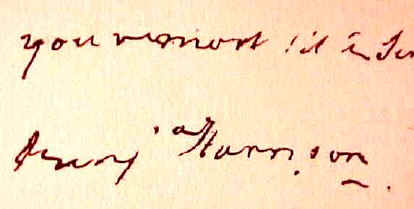
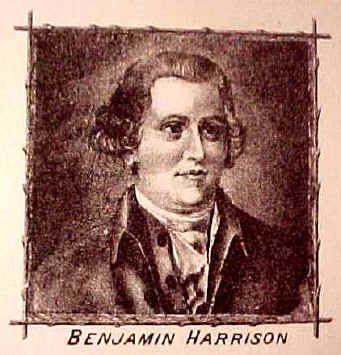
BENJAMIN HARRISON was
born in 1726 on Berkeley, the family plantation beautifully situated on the
banks of the James River overlooking the seaport of Petersburg and
Richmond.He was a descendant of a
family long established in Virginia, his father having married the eldest
daughter of the King's surveyor general.Young Harrison was the eldest son of ten children.He was a student in the College of William and Mary when, his father and two of his sisters were all killed in the mansion
house, by a lightning strike during a thunderstorm.Harrison left college before graduation and returned home to
manage his father's estate.Although he
was considered young to be entrusted with such a charge, he displayed unusual
good judgment and prudence in his responsibilities.
Harrison's family had long been distinguished as
political leaders and he was appointed at an early age to sustain the
reputation to which he had been born.He started his political career around 1764 and he continued to hold
political offices throughout his lifetime, being elected to a seat whenever his
other offices permitted.As a member of
the provincial assembly, Harrison soon became outstanding.He united common good sense with great
firmness and the ability to make decisions.Besides being quite wealthy, and having made respectable connections by
marriage, he was naturally a political leader and he held the confidence of his
constituents.The British, being aware
of his influence and respectability, were anxious to have him, and proposed to
name him a member of the executive council of Virginia, a position few would
have had the firmness to decline.
Harrison, although a young man, was not seduced by
the rank conferred by office.In
opposition to the British, he identified himself with the people, whose rights
and liberties he pursued with zeal.As
a member of the House of Burgesses in 1764, he served on the committee that
prepared the memorials to the King, Lords and commons, but in 1765, he opposed
the stamp act resolutions.He was
chosen in 1773 as one of the committee of correspondence that united the
colonies against Britain.In 1774, he
was appointed one of the delegates to the continental congress and was four
times re-elected to that seat.
Harrison was witty, jovial and entertaining,
having a wry, often black sense of humor that delighted his fellow
congressmen.When there was discussion
about the possibility of being hanged for signing the Declaration of Independence,
the heavyweight Harrison was reported to have uttered to Elbridge Gerry, a very
thin man, "I shall have all the advantage over you.It will be all over in a minute for me, but you will be kicking
in the air half an hour after I am gone."Harrison loved his family and his several large plantations and was an
intimate friend of George Washington.He married Elizabeth Bassett and they had seven children who survived
infancy. Of his children, his third son, William Henry Harrison, would become
the ninth President of the United States.His great grandson, Benjamin Harrison, would become our twenty-third
President.
During nearly every session of congress, Harrison
represented his state of Virginia, distinguishing himself in many important
positions.He was chairman of the board
of war and held that office until he left congress in 1777.He was also often called to preside as
chairman of the committee of the whole house, in which post he was extremely
popular.He occupied that chair during
the deliberations on the dispatches of General Washington, the settlement of
commercial restrictions against Britain, the state of the colonies, the
regulation of trade and during the momentous question on the debates for the
declaration of independence.
Towards the end of 1777, Harrison resigned his
seat in congress and returned to Virginia.He was once again elected to his state legislature.In 1782, he was elected to the office of chief
magistrate of Virginia and became one of the state's most popular governors.He was twice re-elected governor and in
1785, having become ineligible by the provisions of his state's constitution,
he returned to private life, carrying with him the esteem of his fellow
citizens.
In 1788, when the new constitution of the United
States was submitted to Virginia, he was elected a member of the state
convention.Owing to his advanced
years, and to increasing attacks of gout, he did not take a very active part in
the debates of the convention.He was
generally in favor of the constitution, provided certain amendments could be
made to it, but voted against its unconditional ratification.
In the spring of 1791, Harrison was
again severely attacked by gout, and he partially recovered.In the month of April, he was again elected a member of his state
legislature.On the evening
of the day after his election, following a festive party in celebration
of his election, he was again stricken with gout and died at Berkeley
on April 24, 1791.
We invite you to read a transcription
of the complete text of the Declaration as presented by the National Archives.
&
The article "The
Declaration of Independence: A History,"
which provides a detailed account of the Declaration, from its drafting through
its preservation today at the National Archives.
Virtualology welcomes
the addition of web pages with historical documents and/or scholarly papers on
this subject.To submit a web link
to this pageCLICK
HERE.Please be sure to
include the above name, your name, address, and any information you deem
appropriate with your submission.
Unauthorized Site:
This site and its contents are not affiliated, connected,
associated with or authorized by the individual, family,
friends, or trademarked entities utilizing any part or
the subject's entire name. Any official or affiliated
sites that are related to this subject will be hyper
linked below upon submission
and Evisum, Inc. review.
Please join us in our mission to incorporate The Congressional Evolution of the United States of America discovery-based curriculum into the classroom of every primary and secondary school in the United States of America by July 2, 2026, the nation’s 250th birthday. , the United States of America: We The
People. Click Here