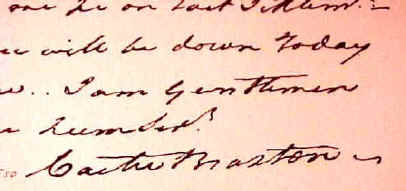
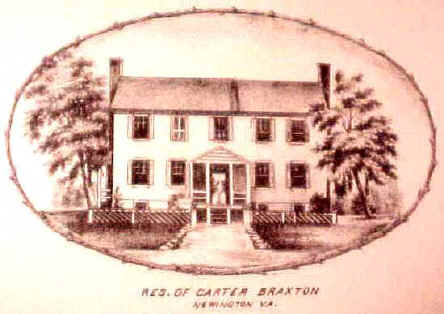
CARTER BRAXTON was
born on his father's successful tobacco plantation in Newington,
Virginia on September 10, 1736.He
was educated at William and Mary College and, while still in his teens,
inherited the large family estate upon the death of his father.At the age of nineteen he married a wealthy heiress named Judith
Robinson, who died two years later, leaving two daughters.
After the death of his wife, Braxton spent three
years in England and upon his return home, he in 1761 he married
Elizabeth Corbin, the daughter of a British colonel who was the Receiver
of Customs in Virginia for the King.He lived in great splendor in richly furnished mansions on two of
his plantations and he produced a total of sixteen children, though only
ten of these survived infancy.
Braxton entered the House of Burgess about that time
and in 1765 he supported Patrick Henry's Stamp Act Resolutions with
vigor as the imposition of import taxes were adversely affecting his own
business interests.Braxton
was elected in 1774 to the convention that met in Williamsburg after
Lord Dunmore's dissolution of the assembly, and it was in that body he
recommended a general congress of the colonies.The convention agreed to make a common cause with Boston and to
break off commercial association with Britain.
The Virginia convention upon reassembling in March
1775, adopted measures for the defense of the country, and for the
encouragement of domestic production of textiles, iron and gunpowder.On April 20, 1775 Lord Dunmore had taken powder belonging to Virginia
to a British vessel in the James River.Patrick Henry, a leader of the militia, flew to arms and refused
to disband his troops and insisted upon making reprisals on the King's
property in an amount sufficient to cover the value of the powder.Braxton interceded and obtained from his father-in-law, the
receiver general of customs, a bill on Philadelphia for the amount of
Patrick Henry's demand.Henry
dismissed his men and bloodshed was for the time averted.
However, Braxton did not share the same zeal for freedom
from England as did his colleagues.He was convinced that a possible civil war was far more dangerous
than democracy.Braxton was
chosen on December 15, 1775 to succeed Peyton Randolph as delegate to
the Continental congress when Randolph died in October 1775, and took
his seat in February 1776.Eloquently,
he took to the floor of Congress to air his opposition to a hasty and
complete break from England.No
record exists on how Braxton actually voted.However, he signed the document on August 2, 1776.Nine days later he returned to Virginia where he took his former
seat in the state legislature. He served there in various capacities
until his death.
The great fortune that Braxton inherited he risked in
extensive commercial enterprises.During
the Revolutionary War, just about every shipping vessel in which he held
an interest was either sunk or captured by the British.He fell deeper and deeper in debt and was forced to sell off his
vast land holdings and the debts due him became worthless on account of
the depreciation of the currency.
Carter Braxton died of a stroke on October 10, 1797
at the age of sixty-one.
We invite you to read a transcription
of the complete text of the Declaration as presented by the National Archives.
&
The article "The
Declaration of Independence: A History,"
which provides a detailed account of the Declaration, from its drafting through
its preservation today at the National Archives.
Virtualology welcomes
the addition of web pages with historical documents and/or scholarly papers on
this subject.To submit a web link
to this pageCLICK
HERE.Please be sure to
include the above name, your name, address, and any information you deem
appropriate with your submission.
Carter Braxton (September 16, 1736 – October 10, 1797), was a signer of
the United States Declaration of Independence and a representative of Virginia.
He was born on Newington Plantation in
King and Queen County, Virginia and educated at the
College of William and Mary. He married a wealthy heiress named Judith
Robinson at the age nineteen, but she died two years later, leaving him two
daughters, and he journeyed to
England for
two years. (Two of Judith's first cousins once removed were loyalists,
Christopher Robinson and cousin Beverley Robinson). Braxton returned to
the colonies in 1760, marrying again, this time to Elizabeth Corbin, and
represented
King William County in the
Virginia
House of Burgesses. He joined the patriot's
Committee of Safety in Virginia in 1774 and represented his county in the
Virginia Convention. When
Peyton Randolph died in 1775, Braxton was appointed to take his place in
the
Continental Congress. He served in the Congress from February 1776 until
August, when Virginia reduced its delegation to five members. Afterwards he
returned to the House of Burgesses, and later served on the State's Executive
Council.
Braxton invested a great deal of his wealth in the
American Revolution. He loaned money to the cause and funded shipping and
privateering. The British destroyed Braxton's shipping investments and
several of his plantations were destroyed during the war as well. Braxton
accumulated a great deal of debt from the war and never recovered financially.
He was forced to sell his estate in 1786 and move to a smaller residence
("row-house") in
Richmond.
Chericoke
and
Elsing Green are some plantations at which he resided. Chericoke is still
in the family's possession today and Elsing Green is available for tourism.
His great-grandson
Elliott Muse Braxton was elected to the Forty-second Congress (March 4,
1871-March 3, 1873). Another great-grandson was
John W. Stevenson, who was Governor of
Kentucky
and member of the U.S. Senate also from Kentucky.
Unauthorized Site:
This site and its contents are not affiliated, connected,
associated with or authorized by the individual, family,
friends, or trademarked entities utilizing any part or
the subject's entire name. Any official or affiliated
sites that are related to this subject will be hyper
linked below upon submission
and Evisum, Inc. review.
Please join us in our mission to incorporate The Congressional Evolution of the United States of America discovery-based curriculum into the classroom of every primary and secondary school in the United States of America by July 2, 2026, the nation’s 250th birthday. , the United States of America: We The
People. Click Here