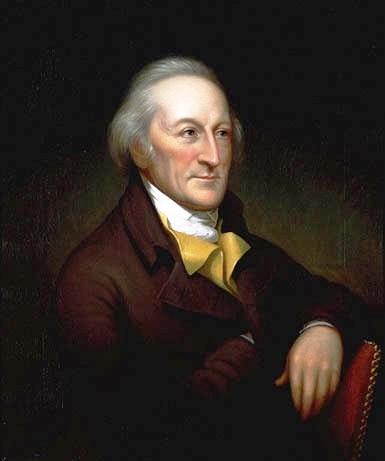
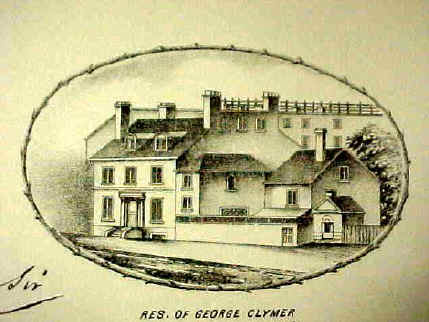
GEORGE
CLYMER was born in Philadelphia on March 16, 1739.His parents died when he was very young, leaving him to be
brought up by a merchant uncle, William Coleman who, according to
Benjamin Franklin, had "the coolest, clearest head, the best heart,
and the exactest morals of almost any man I ever met with."Clymer's appreciation of philosophy and fine literature
flourished under his uncle's roof.Clymer was educated at the College of Pennsylvania and then
entered into his uncle's business.In 1765 he married Elizabeth Meredith, herself the daughter of a
merchant.Clymer formed
another partnership with his father-in-law and brother-in-law
"Merediths & Clymer".He
first met George Washington in his father-in-law's house and they
formed a lasting friendship.
A modest
man and cool on the surface, Clymer never sought public office, but for
a score of years he was in almost unbrokern public service, showing
consistent republicanism and unusual warmth of devotion.An active Patriot from his very young manhood, he was one of the
five elected to Congress from Pennsylvania for the first time in July
1776.
While no orator, this handsome man was well informed, a witty conversationalist,
and a good writer.At the
time of the signing of the Declaration, George Clymer was a prosperous
merchant who was praised as one of the wisest of all delegates,
excepting Benjamin Franklin. His "dearest wish" came to life when he
signed the Declaration.
In
December 1776, when Congress fled from Philadelphia to Baltimore, he and
George Walton and Robert Morris remained behind to carry on
congressional business. After the British victory at the Battle of
Brandywine, British troops advancing on Philadelphia detoured for the
purpose of vandalizing Clymer's home in Chester County about 25 miles
outside the city.
Clymer,
as a member of the first Congress under the Constitution remained loyal
to his friend Washington, but tended to side with Madison against
Hamilton.Clymer declined re-election and was appointed by Washington as head of the excise tax
department for Pennsylvania.He
found the office distasteful and resigned after his son Meredith, who
was in the army dispatched against the Whiskey Rebels in 1794, died in
Pittsburgh.Clymer was a
member of the commission that negotiated a treaty in 1796 with the
Cherokee and Creek Indians in Georgia.It was his last public service.In his retirement, Clymer devoted himself to fine arts and
scientific agriculture.He
had nine children by his marriage with Elizabeth Meredith, of whom five
had survived infancy.George
Clymer died at his Philadelphia home on January 23, 1813, nearly seventy-four years old.
We invite you to read a transcription
of the complete text of the Declaration as presented by the National Archives.
&
The article "The
Declaration of Independence: A History,"
which provides a detailed account of the Declaration, from its drafting through
its preservation today at the National Archives.
Virtualology welcomes
the addition of web pages with historical documents and/or scholarly papers on
this subject.To submit a web link
to this pageCLICK
HERE.Please be sure to
include the above name, your name, address, and any information you deem
appropriate with your submission.
Unauthorized Site:
This site and its contents are not affiliated, connected,
associated with or authorized by the individual, family,
friends, or trademarked entities utilizing any part or
the subject's entire name. Any official or affiliated
sites that are related to this subject will be hyper
linked below upon submission
and Evisum, Inc. review.
Please join us in our mission to incorporate The Congressional Evolution of the United States of America discovery-based curriculum into the classroom of every primary and secondary school in the United States of America by July 2, 2026, the nation’s 250th birthday. , the United States of America: We The
People. Click Here