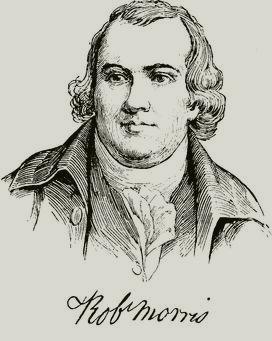
ROBERT
MORRIS was born January 31, 1734 in Liverpool, England.At the age of thirteen, he left England and joined his father of
the same name, who was engaged in the exportation of tobacco on the
Chesapeake Bay in Maryland. The boy was sent to Philadelphia, where he
had slight schooling, and soon was placed in the counting house of
Charles Willing, a wealthy Philadelphia merchant.By his diligence and activity he grew in favor and commanded
confidence.After the death
of Mr. Willing, he was taken into partnership by the latter's son,
Thomas, and this connection was maintained until 1793.At the beginning of he Revolution the firm of Willing and Morris
was one of the largest and most prosperous among the commercial houses of Philadelphia.Although
he was strongly attached to Britian, in 1765 he joined in the
opposition to the Stamp Act.
Stockton was large in
person, frequently afflicted with asthma, agreeable and lavishly
hospitable in private life> He was more respected and feared as a public
man than he was liked.On
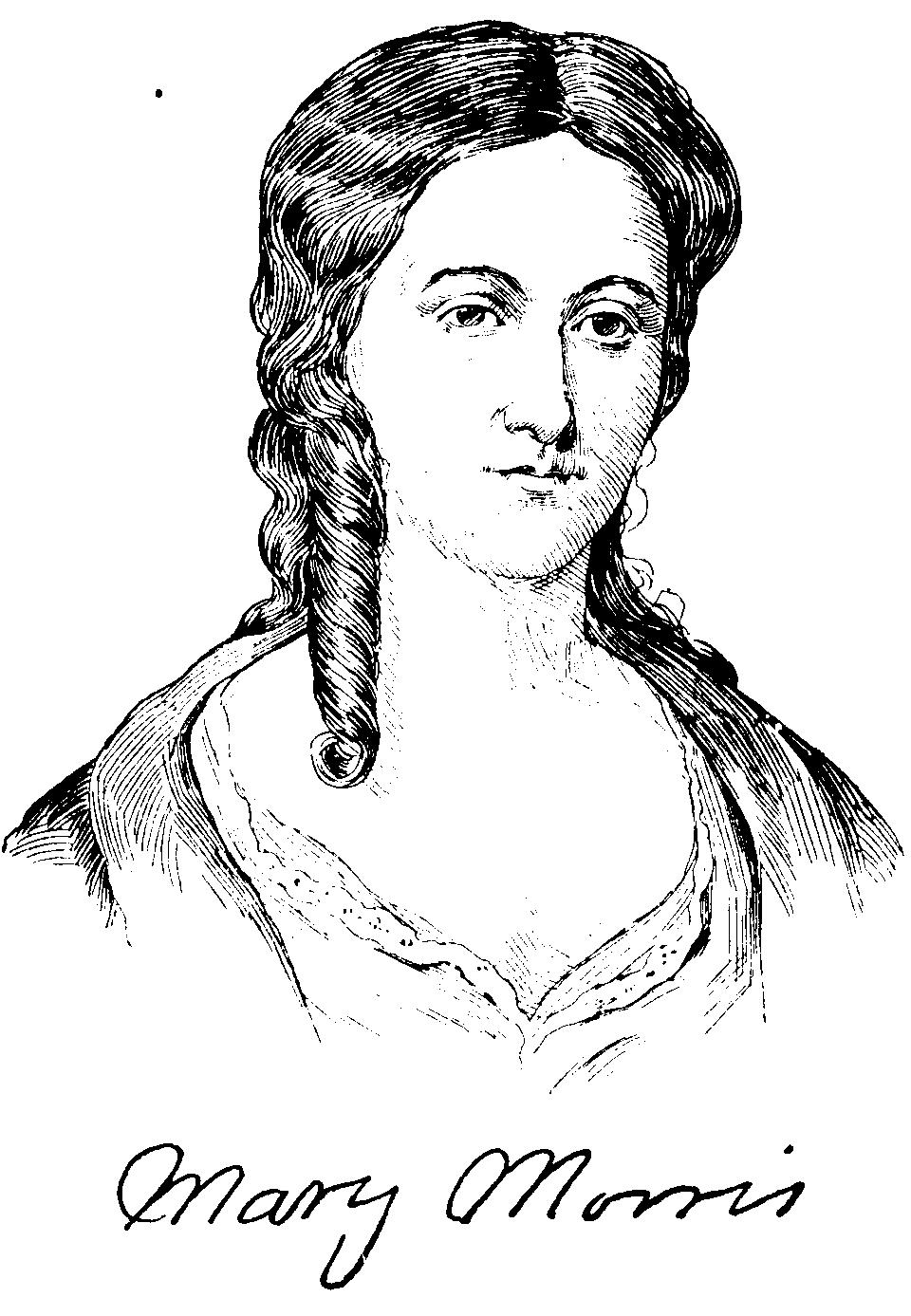
March 2, 1769, Robert married twenty year old Mary White, who was
described as "elegant, accomplished, and rich, and well qualified to
carry the felicity of connubial life to its highest perfection."In 1775 he was elected to the Second Continental Congress and on
July 1, 1776, he voted against the Declaration of Independence, holding
out for reconciliation because he considered that "it was an
improper time". On July 4, 1776, he declined to vote.Yet on August 2, Robert Morris signed the Declaration,
pronouncing that "I am not one of those politicians that run testy
when my own plans are not adopted.I think it is the duty of a good citizen to follow when he cannot
lead."
When
hostilities began, his services became more and more valuable.As a member of the committee of ways and means he worked hard,
and gave to the government the full benefit of his credit.Without Morris's help the campaigns of 1780 would have been
impossible.In 1779, he
supplied General Nathanael Green with munitions of war, and in 1780 he
raised $1,400,000 to assist Washington in the movement that resulted in
the capture of Yorktown.In
February 1781, he was unanimously elected superintendent of finance.As superintendent of finance, he slashed all governmental and
military expenditures, personally purchased army and navy supplies,
strengthened accounting procedures, urged the states to fulfill quotas
of money and supplies, and when necessary used his personal credit by
issuing notes over his own signature or borrowing from friends.
In
December 1781, when the financial situation had become desperate, the
government being $2,500,000 in debt, he organized the Bank of North
America, subscribing $10,000.The bank was incorporated by congress December 31, 1781 and
went into operation January 7, 1782, with a capital of $400,000. It was
the first financial institution chartered by the United States.
In 1787
he was a member of the Constitutional Convention and signed the
Constitution for Pennsylvania. From 1789 to 1795 he served as a member
of the first U. S. Senate from Pennsylvania. When the new
government was organized, he was offered the post of secretary of the treasury, but declined, recommending Alexander Hamilton.In partnership with Gouverneur Morris, he went largely into the
East India and China trade.His
speculations ultimately failed, and in 1798 he was arrested for debt.
He had
sought refuge from is creditors in his country place, ‘The Hills' on
the Schuylkill River, but he was arrested and was confined to the
Prunestreet prison, Philadelphia, from February 1798, until liberated by
the passage of the national bankrupt law in 1802.When misfortune had overtaken him, Mary showed herself a true
wife.Through certain interests in the Holland Land Company,
bequeathed to her by Gouverneur Morris, she obtained from that
corporation a life annuity of $2,000 before she would sign certain
papers to which her signature was indispensable.During her husband's imprisonment Mrs. Morris received an
autograph letter signed by both President and Martha Washington,
addressed to her while residing temporarily at Winchester,Va., urging
her to pay them a visit at Mount Vernon, and to make as long a stay
under "our roof as you shall find convenient; for be assured we ever
have, and still do retain the most affectionate regard for you, Mr.
Morris and the family."Mrs.
Morris continued to reside in Philadelphia, and on her husband's
release he found shelter in the home that her decision and forethought
had secured for him.Robert
Morris's last five years, until his death on May 8, 1806 at the age of
seventy-two were passed in obscure retirement.
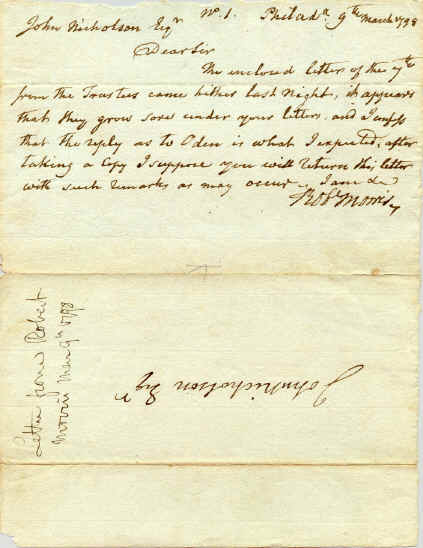
Autograph
letter signed "Robt Morris," dated Philadelphia, 9th March 1798, to John Nicholson, his partner in speculating, from
debtors' prison."The
enclosed letters of the 7th from the trustees came hither
last night.It appears that
they grow sore under your letters and I confess that the reply as to
Oden I expected after taking a copy.I suppose you will return this letter with such remarks as may
occur."Docketed by
Nicholson, who apparently had no remarks to make.Morris and Nicholson had speculated heavily in land together,
but when the bottom fell out of their North American Land Company
venture, Morris was left penniless and deep in debt.His letters from jail are scarce.
We invite you to read a transcription
of the complete text of the Declaration as presented by the National Archives.
&
The article "The
Declaration of Independence: A History,"
which provides a detailed account of the Declaration, from its drafting through
its preservation today at the National Archives.
Virtualology welcomes
the addition of web pages with historical documents and/or scholarly papers on
this subject.To submit a web link
to this pageCLICK
HERE.Please be sure to
include the above name, your name, address, and any information you deem
appropriate with your submission.
MORRIS, Robert, signer of the
Declaration of Independence, born in Liverpool, England, 20 January, 1734; died
in Philadelphia, 8 May, 1806. When he was about thirteen years of age he came to
this country with his father, and soon after his arrival he was placed in the
counting-house of Charles Willing, a wealthy Philadelphia merchant. By his
diligence and activity he grew in favor and commanded confidence. After the
death of Mr. Willing he was taken into partnership by the latter's son, Thomas,
in 1734, and this connection was maintained until 1793.
At the beginning of the Revolution the firm of Willing and Morris was one
of the largest and most prosperous among the commercial houses of Philadelphia.
Although he was warmly attached to the mother-country, Morris opposed the Stamp-Act;
and, although it was contrary to his business interests, he signed the
non-importation agreement of 1765. In 1775 he was sent as a delegate to the
Continental congress, and while serving in that capacity he voted, 1 July, 1776,
against the Declaration of
Independence, and on 2nd and 4th July declined to vote. But when the
Declaration was adopted on August 2, 1776 he appended his name.
He was re-elected to congress in 1777, and again in 1778. When hostilities
began, his services became more and more valuable. As member of the committee of
ways and means he worked hard, and gave to the government the full benefit of
his credit. Without Morris's help the campaigns of 1780 would have been
impossible. In the former year he supplied General
Nathanael Green with munitions of war, and in the latter year he raised
$1,400,000 to assist Washington in the movement that resulted in the capture of Yorktown.
In February, 1781, he was unanimously elected superintendent of finance.
In December of the same year, when the financial situation had become desperate,
the government being $2,500,000 in debt, he organized the Bank of North America,
subscribing $10,000. The bank was incorporated by congress, 31 December, 1781,
and went into operation, 7 January, 1782, with a capital of 8400,000. Morris
resigned his post as superintendent of finance in January, 1783, tired of the
continual worry and excitement, but he was induced to continue until November,
1784, when he retired. The bank charter was annulled by the Pennsylvania
legislature in the last-named year, but Morris was successful in having it
renewed in 1786.
In the latter year he was elected a member of the Pennsylvania
legislature, and in 1787 he was a member of the convention that framed the
United States constitution. On 1 October, 1788. he was elected a member of the
first United States senate, which post he retained till 1795. When the new
government was organized, he was offered the post of secretary of the treasury,
but declined, recommending Alexander Hamilton.
In partnership with Gouverneur Morris,
he went largely into the East India and China trade. His speculations ultimately
failed, and he spent several years in a debtor's cell. As a speaker and writer
Morris was fluent and ready. See "Life of Morris," by Daniel Gould
(Boston, 1834); and "Financial Administration of Robert Morris," by A.
S. Bolles (1878). His letters are printed in Jared Sparks's " Diplomatical
Correspondence of the American Revolution" (12 vols., 1829-'30).
Click on an image to view full-sized
--His wife, Mary, was the daughter of Thomas White, who came to this
country from London in early life and settled on the eastern shore of Maryland.
After the death of White's first wife he removed to Philadelphia, and married a
widow named Newman, who resided in Burlington, New Jersey By her he had a son
and a daughter. The former was named William, and became the second bishop of
the Protestant Episcopal church in the United States. Mary, the elder of the two
children, married Robert Morris, 2 March, 1769, when she was a little over
twenty years of age. She has been described as "elegant, accomplished,
and rich, and well qualified to carry the felicity of connubial life, to its
highest perfection." Not only did she preside gracefully over her
husband's luxurious home during his days of prosperity, but, when misfortune had
overtaken him, she showed herself a true wife.
Through certain interests in the Holland land company, bequeathed to her
by Gouverneur Morris, she obtained from that corporation a life annuity of
$2,000 before she would sign certain papers to which her signature was
indispensable. Robert Morris was confined in the Prune street prison,
Philadelphia, from February, 1798, until liberated by the passage of the
national bankrupt law in 1802. During her husband's imprisonment Mrs. Morris
received an autograph letter signed by both President
and Martha Washington, addressed to her while
residing temporarily at Winchester, Virginia, urging her to pay them a visit at
Mount Vernon, and to make as long a stay under "our roof as you shall
find convenient ; for be assured we ever have, and still do retain, the most
affectionate regard for you, Mr. Morris, and the family." Mrs. Morris
continued to reside in Philadelphia, and on her husband's release he found
shelter in the home that her decision and forethought had secured for him.
--His grandson, Henry W. Morris, naval officer, born in New York city in
1806: died there, 14 August, 1863, was the son of Thomas, a member of the New
York bar, and at one time United States marshal for the southern district of the
state of New York. He entered the navy, 21 August, 1819, and from 1828 till
1838, under the commission of lieutenant, served in various posts. From 1839
till 1845 he was on special duty in New York city, passing through six degrees
of official promotion during the term of six years. He was then appointed to the
command of the store-ship "Southampton," at that time belonging
to the African squadron. In 1846 he was again ordered to the Brooklyn navy-yard,
where for the next five years he was awaiting orders. In the mean time he was
promoted commander, and in 1851 was appointed to the charge of the rendezvous in
New York until 1853, when he was ordered to the sloop-of-war "Germantown,"
of the Brazilian squadron. In 1855 he was transferred to the Mediterranean
station, where he served as fleet-captain under Commander Stringham. Upon his
return to the United States, in 1856, he received his commission as
captain.
Toward the close of 1861 he superintended the construction of the steam
sloop-of-war "Pensacola" at Washington navy-yard. In January,
1862, that vessel, under his command, successfully passed the line of
Confederate batteries on the Potomac, and, after anchoring a short time in
Hampton roads, set sail to join the blockading squadron in the Gulf of Mexico.
The " Pensacola" played a brilliant part in all the attacks
upon Fort Jackson and Fort St. Philip, and upon the Chalmetre batteries. After
the capture of New Orleans, Commander Morris was entrusted with the duty of
holding the city and guarding the adjacent coasts. But his health became
seriously affected, and he was persuaded to come to the north to recruit his
strength, and died soon after his arrival. He was made commodore, 16 July, 1862.