Commander-in-Chief
United Colonies of America
George Washington: March
1, 1781 - December 23, 1783
Thomas Mc Kean, a signer of the
Declaration of Independence, was born in New London, Chester County,
Pennsylvania on March 19, 1734 and died in Philadelphia, Pennsylvania, June 24,
1817. Mc Kean’s parents were both natives of Ireland. He studied with the
Reverend Francis Allison, who was at that time, a renowned teacher of New
Castle, Delaware. McKean was of Scottish-Irish descent and was a man of
energetic personality, "with a thin face, hawk's nose and hot eyes."
McKean had important family
connections in Delaware and used them to his advantage to pursue a career in
politics. He was admitted to the bar before he was twenty-one years old,
appointed deputy attorney general of Sussex County a year later, and served as
clerk of the assembly from 1757 to 1759. In 1762 McKean, along with Caesar
Rodney became reviser of laws that had been passed previous to 1752. In October
of that year he was elected to the Colonial General Assembly, holding office for
seventeen successive years, during the last of which he resided in Philadelphia.
Mc Kean was a trustee of the
loan-office of New Castle County for twelve years, and in 1765 he was elected to
the Stamp Act Congress. Had the votes in this body been taken according to the
population of the states that were represented, Delaware’s influence would have
been insignificant. McKean, realizing this, successfully brokered a resolution
giving, each colony an equal voice.
McKean was one of the most
influential members of the Stamp Act Congress, serving on the committee that
drew the memorial to the House of Lords and Commons and, with John Rutledge and
Philip Livingston, revised its proceedings. When business was concluded on the
last day of its session, and Timothy Ruggles, the president of the body, as
well as a few other timid members, refused to sign the memorial of rights and
grievances, McKean arose, and insisted that the president give his reasons for
his refusal. After a pause Ruggles remarked, "it was against his conscience."
McKean then rang the changes on the word "conscience" so loudly and
so long that a duel challenge was given and accepted between himself and
Ruggles in the presence of the congress. Ruggles hastily left the next morning
at daybreak, so that the duel could not take place.
In July of the same year McKean was
appointed sole notary of the lower counties of Delaware and judge of the court
of common pleas, and of the orphans' court of New Castle. In November of 1765 he
ordered that all the proceedings of this court be recorded on un-stamped paper;
this was the first court in the colonies that established such a rule. He was
collector of the port of New Castle in 1771, Speaker of the House of
Representatives in 1772. In 1774 he was elected a member of the Continental
Congress.
In September 1774, he had just
married his second wife, Sarah Armitage of New Castle. His first wife, Mary
Borden, the daughter of Joseph Borden of Bordentown, New Jersey, and sister of
the wife of Francis Hopkinson, died in 1773, leaving him with six children. He
would father five more children with his second wife.
He was the only member that served in
Congress from its 1774 opening until the Treaty of Paris, representing Delaware
until 1783. Mc Kean was chief justice of Pennsylvania from July 1777 until 1799;
he also occupied a seat in the Delaware
legislature until 1799. During Congressional session in 1776 he was a member of
the committee to state the rights of the colonies, as well as a member of the
secret committee to contract for the importation of arms. He was also selected
to prepare and digest the draft of the Articles of Confederation to be entered
into between the colonies, which he signed on behalf of Delaware in 1777. He
superintended the finances and a variety of important measures in the
Continental Congress.
At the Second Congress, McKean was a
true fighter for independence. Since the Stamp Act of 1765, he had opposed
British rule. He believed that the crown had "no right to regulate American
affairs in any way". In June 1776, McKean returned to Delaware and gained
authority for its delegates to vote for independence. Although he was
particularly active in procuring the Declaration to which his name is subscribed
to the engrossed instrument, McKean does not, through a mistake on the part of
the printer, appear as a subscriber in the copy published in the Journal of The
Continental Congress. A few days after McKean cast his vote, he left Congress to
command a battalion of troops to assist Washington at Perth Amboy, New Jersey.
He, therefore, was not available when most Signers placed their signatures on
the Declaration on August 2, 1776. There is considerable question as to when
McKean did actually signed the Declaration of Independence in 1776. He claimed
in old age that he attached his name some time in 1776, but his name did not
appear on the printed copy that was authenticated on January 17, 1777. It is
assumed that he signed after that date while attending Congress in Philadelphia.
In July 1776, he was served as
chairman of the delegates from New York,
New Jersey, Delaware and Pennsylvania committee. In that same year, his talents
were so much in demand that the Delaware delegate also served as chairman of the
Pennsylvania committees of safety and inspection as well as the Philadelphia
committee of observation. On his return to Dover McKean found a committee
awaiting him to urge him to prepare the Constitution of Delaware, which he drew
up on the night of his arrival, and which was unanimously adopted by the
assembly the next day.
In
1777, while acting in the double capacity of President of Delaware and Chief
Justice of Pennsylvania, he describes his perils in a letter to his intimate
friend, John Adams, as
"hunted like a fox by the enemy,
compelled to remove my family five times in three months, and at last fixed them
in a little log-house on the banks of the Susquehanna, but they were soon
obliged to move again on account of the incursions of the Indians."
As a delegate to the Continental
Congress he was present when the Articles of Confederation were ratified on
March 1, 1781. By virtue of this ratification the ever fluid Continental
Congress ceased to exist and on March 2nd "The United States in Congress Assembled" was placed at the head of
each page of the Official Journal of Congress. The United States of America,
which was conceived on July 2, 1776, had finally been born in 1781 under the
1st U.S. Constitution.
By May of 1781, President
Huntington's health began to fail. Huntington,
despite the pleadings of the delegates, tendered his resignation as President on
July 6, 1781. The United States in Congress Assembled Journals reported:
"The President having informed the
United States in Congress assembled, that his ill state of health" ... not
permit him to continue longer in the exercise of the duties of that office".
Congress held off electing a new
President until July 10th in the hope that Huntington would recover and
reconsider. On July 8th, 1781 Thomas McKean wrote
to Samuel Adams of the summer events:
“Since you left us we have been
going on nearly in the old tract, tho' the General Assemblies of this State,
Delaware and Maryland, by their late exertions (being at last thoroughly roused)
have granted such effectual Aids, as must enable us in a little time to hold up
our heads again. The Army under General Green has been successful; Augusta in
Georgia and all the enemies posts in that State, except Savanna, are certainly
in our possession; and I believe Fort Ninety Six, and all other Posts of the
enemy in South Carolina, except Charles-Town, are also wrested from them. There
were an hundred barrels of powder, and a considerable quantity of other military
Stores and provisions, found in Augusta, and about five hundred Prisoners taken
there and in its neighbourhood. A general exchange of prisoners has taken place
to the Southward, and our good old friend General Gadsden is expected here in a
few days. All the Refugees and Tories taken on our part have been given up for
all our Militia taken by the enemy; this was agreed to without any reference to
numbers or rank on either side.
A new President of Congress is to
be chosen tomorrow, as Mr. Huntington will not continue any longer; this honor
is going a begging; there is only one Gentleman, and he from the Southward, who
seems willing to accept, but I question whether he will be elected. There are
some amongst us, who are so fond of having a great and powerful man to look up
to, that, tho' they may not like the name of King, seem anxious to confer kingly
powers, under the titles of Dictator, Superintendent of Finance, or some such,
but the majority do not yet appear to be so disposed.
The Harvests in Pennsylvania and
the adjoining States promise to be double in quantity and better in quality than
in any year during the last twenty, and the whole Country teems with fruit. In
short that good Providence that has protected and blessed us hitherto, appears
now to take us under his most particular care; for everything augurs well."
Surprisingly, this letter gives no
indication on July 8th that Thomas McKean was even considering a candidacy for
the first election, "this honor is going begging," of the President of
the United States.
It was no wonder that McKean didn’t
seek the office as these were perilous times. On July 6, 1781 General
Cornwallis moved along the James River at Green Spring, Virginia towards
YorkTown and set a trap for the young French General. Cornwallis hid the fact
that his entire detachment had not crossed the River but lied in wait for the
Continental Army to attack what appeared to be his rear guard and some baggage.
Continental reinforcements arrived just in time to capture this British prize
and Wayne now had 900 men. Fortunately Lafayette uncovered the plot, never
attacked and halted Wayne's engagement into a well-organized retreat of all the
continental forces along the James River. The Marquis de Lafayette just barely
escaped, along with General Wayne, what could have been a crushing defeat for
the United States along the James River.
On July 7, 1781,
General Cornwallis with Lafayette in full retreat finished crossing the James
River on his march to Yorktown, Virginia. On the 8th of July Cornwallis received
orders from General Clinton to now send the 3,000 men to capture Philadelphia
and disrupt the new Federal Government. On July 9th Cornwallis once again
detached Lt. Colonel Tarleton to destroy supplies and stores in Virginia.
During this time the
United States in Congress Assembled elected a second Confederation President and
it was not Thomas McKean but Samuel Johnston of North Carolina. Johnston
declined holding the office and another election was ordered.
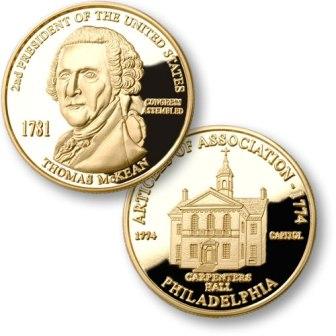
On July 10th Delegate Thomas McKean
was elected as the second President of the United States in Congress Assembled
and was first to be elected under a ratified Articles of Confederation, as
President Huntington assumed the position as the former President of the
Continental Congress.
Thomas McKean came into the
presidency at the beginning of the end of The Revolutionary War. His first
dispatch on July 11th was granting permission to James and William Winthrop of
Massachusetts
to occupy the barracks, standing
without the fortifications on Governor's Island, in the harbor of Boston, for
the purpose of a barn.
His last military letters in November
as President would be to congratulate a host of military leaders on their
success at Yorktown.
So revered was this office by Thomas
McKean that this U.S. Presidency would be eventually used to turn down his
party's 1804 nomination for Vice President under Thomas Jefferson with the
former President stating:
"... President of the United
States in Congress Assembled in the year of 1781 (a proud year for Americans)
equaled any merit or pretensions of mine and cannot now be increased by the
office of Vice President."
Although McKean's tenure as US
President was quite brief, it was an eventful period in US History, beginning
with Samuel Johnson the first President of the United States in Congress
Assembled duly elected under the Articles of Confederation declining the
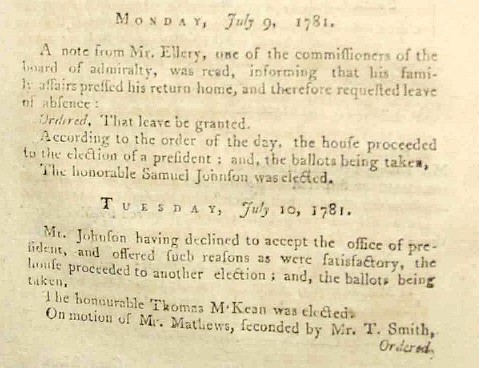
office with the Journals recording July 10th:
“Mr. [Samuel] Johnston having
declined to accept the office of President, and offered such reasons as were
satisfactory, the House proceeded to another election; and, the ballots being
taken, the hon. Thomas McKean was elected..”
18th Century
Journal of the United States in Congress Assembled reporting
the election of Thomas McKean - Courtesy of the Author.
Thomas Rodney's letter to Caesar
Rodney of Delaware dated the same day reported:
P.S. Congress has been
endeavouring some time past to elect a new President Mr. Huntington having often
applied for leave to go Home on Account of his health and private affairs, and
Yesterday Mr. Johnson of N. Carolina was appointed but he declined it on Account
of his Bad State of health, and To day Mr. McKean was appointed and prevailed on
to serve Till October next at Which Time he says he is determined To decline
serving in Congress any longer
The reasons for Johnson's refusal to
not serve are unclear but some historians claim his letter of July 30th 1781
clearly indicated he was in no position to accept an office which offered no
salary:
“Having no prospect of being relieved
or supplied with money for my expenses and my disorder, which abated a little on
the first approach of warm weather, returning so as to render me of little use
in Congress I left Philadelphia the 14th, for which I hope I shall be held
excusable by this state..”
Johnston's letter to James Iredell
only one month earlier supports that conclusion for not accepting the U.S.
Presidency reporting:
"I thought about this time to be
making preparations for leaving this place, but none of my colleagues appearing
to relieve me, several States being unrepresented in Congress, and affairs of
the first magnitude being now on the tapis, I thought it inconsistent with my
honor to leave the State unrepresented at so interesting a period.
Notwithstanding my anxious impatience to return to my family, I have determined
to stay till I am relieved, or at least till the States are more fully
represented in Congress. I don't doubt but you and my sister will offer such
reasons to Mrs. Johnston as will reconcile her to this measure. I hope she will
keep up her spirits and if I should not return before the sickly season, I wish
you would prevail on her to take the children down to the sea-side, if it can be
done with safety; but as I have hopes of returning before that time, it will be
unnecessary to say any thing on the subject till the season approaches.
The uncertainty of a letter's
getting safe to you, lays me under great restraints. I can only mention in
general that the King of France has given us under his own hand very lately, the
most unequivocal assurances of his friendship and support, and is at this time
exerting his interest and influence at the different courts in Europe to bring
our affairs to a happy and speedy conclusion; and I have in my own mind the most
perfect confidence in these assurances. We shall suffer much in this campaign;
it will be very bloody, but I hope it will be the last. I may be disappointed,
but was I at liberty to commit my reasons to writing, you would not hesitate to
subscribe to my opinion.
Our prospects are very fair in
Europe, but it is necessary we should exert ourselves here, for every advantage
we gain this summer will count as so much solid coin. We are in daily
expectation of hearing from the General, who has been lately at Connecticut
to consult the officers of the French army and navy. My hopes and expectations
of a favorable issue to our troubles are very sanguine; but human affairs are
governed by such a variety of whimsical circumstances, that we should always be
prepared to stand the shock of that disappointment which the best concerted
measures are constantly subject to. Present my love to my sisters, the children,
and all friends. Let my brother see this and the newspapers, when you have an
opportunity. I present my best wishes to him, and his family. I wish much to
hear from you and him, and am, with the most sincere affection and esteem,"
On June 27th just 13 days before his
election to the Presidency Johnson also writes:
I was only yesterday favored with
the letters which you were so obliging as to write me the 14th of April and 10th
of May last. I have wrote to you frequently by casual opportunities, but cannot
have any confidence of your having received my letters. I write by this
opportunity to my brother, and must refer you to his letter and the enclosed
newspaper for news. I am sorry people were in such haste to remove themselves
and property from Edenton. I rather could have wished they had thought of
defending it, which would have been attended with less risk and expense in my
opinion, for till the conquest of Virginia is effected, which I flatter myself
will not speedily take place, I scarcely think you will be molested with any
considerable invasion, and if the plundering parties meet with opposition they
will grow sick of the business. However, every one will and has a right to judge
for himself on these occasions. So far as it respects me, I am perfectly
satisfied, and shall ever consider myself under the highest obligations to you
on this occasion for your friendly attention. I have been detained here longer
than I expected from unavoidable circumstances, which I shall have the pleasure
of communicating when I can see you. I hope to leave this place some day next
week but as it will be necessary for me to take a pretty extensive circuit to
avoid the enemy's horse, and the weather being too warm for me to make long
days' journeys at this season, I cannot form to myself any judgment respecting
the time I shall arrive with you. I am truly sensible what anxiety and distress
you must all have sustained in your alarming situation. I have often wished to
have been with you on the occasion; indeed my mind has been so much in that
country, that it has rendered me almost incapable of attending to any thing
elsewhere. This will probably be a very important, though perhaps not a decisive
campaign. I am not perfectly informed of the plan on which it will be conducted
on our part, nor is it proper that I should communicate so much as I do know to
paper. Should a few fortunate events cast up in our favor, I hope there will be
no more of it after this summer-if otherwise, God knows where it will end, for
America can never submit.
Pray remember me most affectionately
to my sister and the children. I grow every day more impatient of being absent
from my friends; and had I not believed my services, or rather my vote
essentially necessary here for some time past, no importunity should have
detained me.
North Carolina, with
Samuel Johnson's decline, lost the opportunity to declare that one of her sons
held the Presidency of the United States in Congress Assembled.
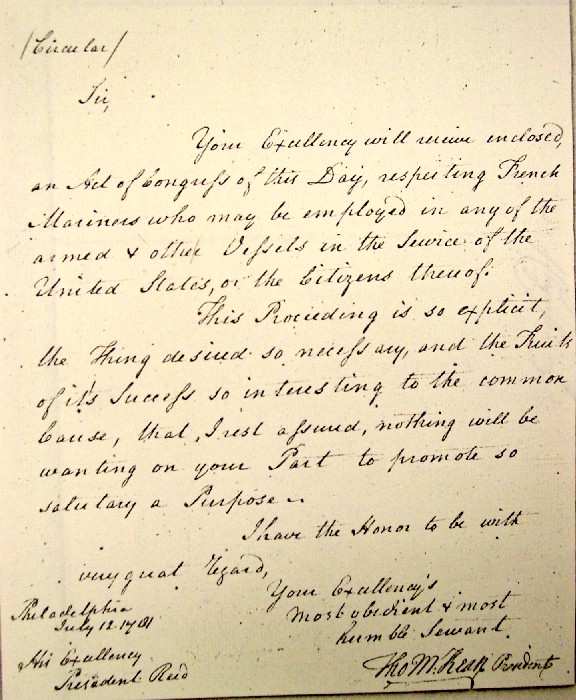
President Thomas McKean Autograph Letter Signed to President
Reed of the Supreme Council of Pennsylvania discussing French
Marines - Courtesy of the Author.
McKean's Presidency is most curious
for another reason. The Signer was elected as a Delegate of Delaware but
in 1781 he was also serving as Chief Justice of Pennsylvania. The opposition of
many Pennsylvanians against his Presidency was vicious due to his affiliation
with both States and maintaining that in Congress he represented Delaware. Born
in Pennsylvania, he remained steadfast in his right to serve in both positions
and did not resign the Chief Justice office.
Particularly, a Mr. Tenax's attacks
on McKean for serving in the dual offices of Chief Justice and President did,
however, elicited several public responses from President McKean. Two were
printed in The Freeman's Journal during July and August of 1781. On August 6th
McKean writes:
"QUERIES to TENAX. Do you not know,
that the chief justice of Pennsylvania, was, at the time of his appointment,
speaker of the house of assembly, soon after commander in chief, and for near
four years since constantly a delegate for the Delaware state?
If so, and you thought it a violation
of the constitution, why did you not heretofore mention it to him, or publish
your sentiments as you have now done? Do you not know that the honorable William
Henry Drayton, esq. sat in congress for two years as a member of South Carolina,
being at the same time chief justice of that state; that the honorable William
Paca, esq. was at the same time chief justice and a member of congress for the
state of Maryland; that the honorable John Jay, esq. was chief justice of
New-York during the time he was president of congress; that the honorable
Samuel Huntington, esq. the last president of congress, was, during the whole
time, a justice of the supreme court of Connecticut; and that there are several
of the present members of congress who are justices of the supreme court in
their respective states?
Can the chief justice of Pennsylvania
sit upon the decision of any controversy between that state and any other; or
can a delegate for the Delaware state have any share in
determining whether the islands in the river belong to Delaware or Pennsylvania?
Have you ever read the confederation
of the several states, or do you understand it?
Do you understand the doctrine of
replevins, impeachments, or the rights of sovereign independent states?
Would it not be adviseable to qualify
yourself in this respect, before you assume the office of REFORMER or
CENSOR-GENERAL?
Are you so regardless of all
reputation as to persist in an error in spite of conviction?"
In this powerful, historic work, Stan Klos unfolds the complex 15-year
U.S. Founding period revealing, for the first time, four distinctly
different United American Republics. This is history on a splendid scale --
a book about the not quite unified American Colonies and States that would
eventually form a fourth republic, with
only 11 states, the United States of America: We The People.
Unauthorized Site:
This site and its contents are not affiliated, connected,
associated with or authorized by the individual, family,
friends, or trademarked entities utilizing any part or
the subject's entire name. Any official or affiliated
sites that are related to this subject will be hyper
linked below upon submission
and Evisum, Inc. review.
Please join us in our mission to incorporate The Congressional Evolution of the United States of America discovery-based curriculum into the classroom of every primary and secondary school in the United States of America by July 2, 2026, the nation’s 250th birthday. , the United States of America: We The
People. Click Here