The Declaration of Independence - A Brief History by Stanley L. Klos --
Authenticate your Declaration of Independence
The Declaration of Independence
Authenticate your Declaration of Independence
Click Here
For Full Text of the Declaration of Independence
Click Here by
Stanley L. Klos
"The Union is much older than the Constitution. It was formed, in
fact, by the Articles of Association in 1774. It was matured and continued
by the Declaration of Independence in 1776. It was further matured, and the
faith of all the then thirteen States expressly plighted and engaged that it
should be perpetual, by the
Articles of Confederation in 1778. And finally, in 1787, one of the
declared objects for ordaining and establishing the Constitution was 'to
form a more perfect Union.' "
Abraham Lincoln
First Inaugural
On June 7th, 1776
Richard Henry Lee
brought the following resolution before the Continental Congress of the United
Colonies:
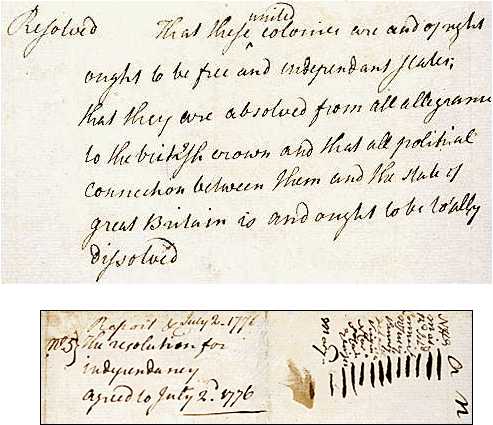
``Resolved, That
these United Colonies are, and of right ought to be, free and independent
states, that they are absolved from all allegiance to the British Crown, and
that all political connection between them and the state of Great Britain is,
and ought to be, totally dissolved.''
[i]
On Saturday, June
8th, Lee's resolution for independence derived from theMay 15, 1776
Resolvesof
theVirginiaConventionwas referred to a committee of the whole (the
entire Continental Congress), and they spent most of that day as well as Monday,
June 10th debating independence. The chief opposition for independence came
mostly from Pennsylvania, New York and South Carolina.
Thomas Jefferson reported that they "were not yet
matured for falling from the parent stem." Since Congress could not agree
more time was needed
"to give an opportunity to the delegates from those colonies which had not
yet given authority to adopt this decisive measure, to consult their
constituents .. and in the meanwhile, that no time be lost, that a committee be
appointed to prepare a declaration".
[ii]
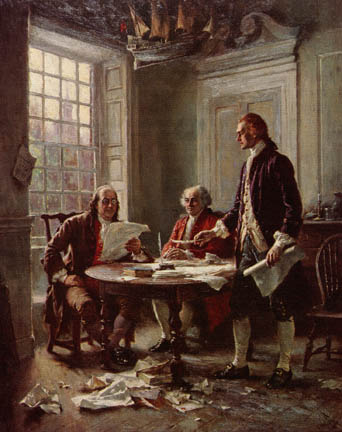
Accordingly, on
June 11th a Committee of Five was chosen with Thomas Jefferson of Virginia being
picked unanimously as its first member. Congress also chose
John Adams,
Benjamin
Franklin,
Robert
R. Livingston, and
Roger
Sherman. The committee assigned Jefferson the task of producing
a draft Declaration, as proposed in Thomas Paine’s Common Sense, for its
consideration.
John Adams in his
autobiography recalls this of Jefferson’s selection as Chairman:
“Mr. Jefferson had been now about a Year a Member of Congress, but had
attended his Duty in the House but a very small part of the time and when there
had never spoken in public: and during the whole Time I satt with him in
Congress, I never heard him utter three Sentences together. The most of a Speech
he ever made in my hearing was a gross insult on Religion, in one or two
Sentences, for which I gave him immediately the Reprehension, which he richly
merited. It will naturally be enquired, how it happened that he was appointed on
a Committee of such importance. There were more reasons than one. Mr. Jefferson
had the Reputation of a masterly Pen. He had been chosen a Delegate in Virginia,
in consequence of a very handsome public Paper which he had written for the
House of Burgesses, which had given him the Character of a fine Writer. Another
reason was that Mr. Richard Henry Lee was not beloved by the most of his
Colleagues from Virginia and Mr. Jefferson was sett up to rival and supplant
him. This could be done only by the Pen, for Mr. Jefferson could stand no
competition with him or any one else in Elocution and public debate.” [iii]
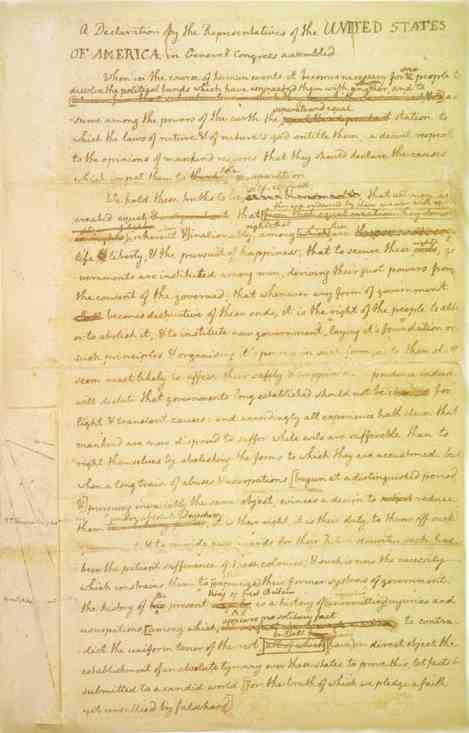
Jefferson's
writing of the original draft took place in seventeen days between his
appointment to the committee until the report of draft presented to Congress on
June 28th. Thomas Jefferson drew heavily on
George Mason's
Virginia Declaration of Rights (passed on June 12, 1776),
Common Sense, state and local calls for independence, and his own work on
the Virginia Constitution.
Jefferson's original
rough draft was first submitted to Benjamin Franklin and John Adams for their
thoughts and changes. Jefferson wrote "… because they were the two members of whose judgments and amendments I
wished most to have the benefit before presenting it to the Committee".
[iv]
The entire
committee reviewed the Declaration after Franklin and Adams's changes. After
much discussion 26 additional changes were made from Jefferson's original draft.
The Committee presented it to Congress on Friday June 28th which ordered it to
lie on the table.
According to
historian John C. Fitzpatrick the Declaration's
"... genesis roughly speaking, is the first three sections of George Mason's
immortal composition (Virginia Declaration of Rights), Thomas Jefferson's
Preamble to the Virginia Constitution, and Richard Henry Lee's resolution..."[v]
Congress was
called to order on July 1st at 9am and serious debate consumed most of that hot
and humid Monday. Late in the day it was apparent that the delegates from
Pennsylvania and South Carolina were not ready to pass the Lee resolution for
Independence. Additionally the two delegates from Delaware were split so debate
was postponed until the following day.
On
the morning of July 2, 1776 the New York Delegates wrote the newly elected
Provincial Congress in NYC for instructions as the vote for independence was
eminent. The NY Provincial Congress had adjourned due to the British Fleet's
arrival off Sandy Hook. Their letter was held until the NY Provincial Congress
reconvened in White Plains. Congress opened that morning with both Robert Morris and
John Dickinson deliberately “abstaining” on the vote for independence by
not attending the session. The remaining Pennsylvania delegation voting
yes for independence.
[vi] South Carolina leader's son, Arthur Middleton,
chose to ignore his absent and ailing father's loyalist wishes changing the colony's
position to yes. Finally the Caesar Rodney, who was summoned by fellow
delegate Thomas McKean,
[vii] arrived suffering from a serious facial cancer and
afflicted with asthma after riding 80 milesthrough the rain and a lightening
storm. He broke Delaware's 1 to 1 deadlock by casting the
third vote for independence. All 12 colonies, except for NY whose delegates were
not empowered to vote, adopted the July 2, 1776 resolution, introduced by Richard Henry Lee and John Adams, declaring
independence from Great Britain.
Richard Henry Lee's Resolution Courtesy of the National Archives
John Adams would
write 29 years later on this July 2, 1776 debate:
“The Subject had been in Contemplation for more than a Year and frequent
discussions had been had concerning it. At one time and another, all the
Arguments for it and against it had been exhausted and were become familiar. I
expected no more would be said in public but that the question would be put and
decided. Mr. Dickinson however was determined to bear his Testimony against it
with more formality. He had prepared himself apparently with great Labour and
ardent Zeal, and in a Speech of great Length, and all his Eloquence, he combined
together all that had before been written in Pamphlets and News papers and all
that had from time to time been said in Congress by himself and others. He
conducted the debate, not only with great Ingenuity and Eloquence, but with
equal Politeness and Candour: and was answered in the same Spirit.No Member rose
to answer him: and after waiting some in hopes that some one less obnoxious than
myself, who was still had been all along for a Year before, and still was
represented and believed to be the Author of all the Mischief, I determined to
speak.
It has been said by some of our Historians, that I began by an Invocation to
the God of Eloquence. This is a Misrepresentation. Nothing so puerile as this
fell from me. I began by saying that this was the first time of my Life that I
had ever wished for the Talents and Eloquence of the ancient Orators of Greece
and Rome, for I was very sure that none of them ever had before him a question
of more Importance to his Country and to the World. They would probably upon
less Occasions than this have begun by solemn Invocations to their Divinities
for Assistance but the Question before me appeared so simple, that I had
confidence enough in the plain Understanding and common Sense that had been
given me, to believe that I could answer to the Satisfaction of the House all
the Arguments which had been produced, notwithstanding the Abilities which had
been displayed and the Eloquence with which they had been enforced. Mr.
Dickinson, some years afterwards published his Speech. I had made no Preparation
beforehand and never committed any minutes of mine to writing.
Before the final Question was put, the new Delegates from New Jersey came in,
and Mr. Stockton, one of them Dr. Witherspoon and Mr. Hopkinson, a very
respectable Characters, expressed a great desire to hear the Arguments. All was
Silence: No one would speak: all Eyes were turned upon me. Mr. Edward Rutledge
came to me and said laughing, Nobody will speak but you, upon this Subject. You
have all the Topicks so ready, that you must satisfy the Gentlemen from New
Jersey. I answered him laughing, that it had so much the Air of exhibiting like
an Actor or Gladiator for the Entertainment of the Audience, that I was ashamed
to repeat what I had said twenty times before, and I thought nothing new could
be advanced by me. The New Jersey Gentlemen however still insisting on hearing
at least a Recapitulation of the Arguments and no other Gentleman being willing
to speak, I summed up the Reasons, Objections and Answers, in as concise a
manner as I could, till at length the Jersey Gentlemen said they were fully
satisfied and ready for the Question, which was then put and determined in the
Affirmative.”
[viii]
John Adams wrote
Abigail Adams on July 3, 1776:
Yesterday the greatest Question was decided, which ever was debated in
America, and a greater perhaps, never was or will be decided among Men. A
Resolution was passed without one dissenting Colony "that these united Colonies,
are, and of right ought to be free and independent States, and as such, they
have, and of Right ought to have full Power to make War, conclude Peace,
establish Commerce, and to do all the other Acts and Things, which other States
may rightfully do."
You will see in a few days a Declaration setting forth the Causes, which have
impell'd Us to this mighty Revolution, and the Reasons which will justify it, in
the Sight of God and Man. A Plan of Confederation will be taken up in a few
days. On July 2, 1776 the Association known as United Colonies of America
officially became the United States of America .[ix]
Consequently, it was the date of July 2, 1776 that John Adams thought would be
celebrated by future generations of Americans writing to his wife Abigail Adams
a second letter on July 3, 1776:
But the Day is past. The Second Day of July 1776, will be the most memorable
Epocha, in the History of America.
I am apt to believe that it will be celebrated, by succeeding Generations,
as the great anniversary Festival. It ought to be commemorated, as the Day of
Deliverance by solemn Acts of Devotion to God Almighty. It ought to be
solemnized with Pomp and Parade, with Shews, Games, Sports, Guns, Bells,
Bonfires and Illuminations from one End of this Continent to the other from this
Time forward forever more.
You will think me transported with Enthusiasm but I am not. -- I am well
aware of the Toil and Blood and Treasure, that it will cost Us to maintain this
Declaration, and support and defend these States. -- Yet through all the Gloom I
can see the Rays of ravishing Light and Glory. I can see that the End is more
than worth all the Means. And that Posterity will tryumph in that Days
Transaction, even altho We should rue it, which I trust in God We shall not.
[x]
After the
resolution was passed the Continental Congress turned to the debate over the
language in the Committee of Five's formal Declaration of Independence. Time was
short and Congress adjourned until Wednesday the 3rd. The debates of July 3rd
and 4th altered the manuscript and with these changes the Declaration of
Independence was considered by the committee of the whole. Thomas Jefferson was disappointed by the
"depredations" made by Congress writing:
"The pusillanimous idea that we had friends in
England worth keeping terms with, still haunted the minds of many. For this
reason those passages which conveyed censure on the people of England were
struck out, lest they should give them offense. The clause too, reprobating the
enslaving the inhabitants of Africa, was struck out in compliance to South
Carolina and Georgia, who had never attempted to restrain the importation of
slaves, and who on the contrary still wished to continue it. Our Northern
brethren also I believe felt a little tender under these censures; for tho'
their people have very few slaves themselves yet they had been pretty
considerable carriers of them to others."
[xi]
Despite these
July 4th changes and previous committee edits Jefferson is rightfully considered
the main author of the Declaration of Independence. John Adams in his
autobiography recalls this of Jefferson’s pen:
The Committee had several meetings, in which were proposed the Articles of
which the Declaration was to consist, and minutes made of them. The Committee
then appointed Mr. Jefferson and me, to draw them up in form, and cloath them in
a proper Dress. The Sub Committee met, and considered the Minutes, making such
Observations on them as then occurred: when Mr. Jefferson desired me to take
them to my Lodgings and make the Draught. This I declined and gave several
reasons for declining. 1. That he was a Virginian and I a Massachusettensian. 2.
that he was a southern Man and I a northern one. 3. That I had been so obnoxious
for my early and constant Zeal in promoting the Measure, that any draught of
mine, would undergo a more severe Scrutiny and Criticism in Congress, than one
of his composition. 4thly and lastly and that would be reason enough if there
were no other, I had a great Opinion of the Elegance of his pen and none at all
of my own. I therefore insisted that no hesitation should be made on his part.
He accordingly took the Minutes and in a day or two produced to me his Draught.
[xii]
Late in the
afternoon on July 4th, 1776 twelve of the thirteen colonies an reached agreement
to formally proclaim themselves as free and independent nations. Only New York
was the lone holdout and it was due to the fact the Delegates were not granted
the authority to vote yea or nay on Independence.
This was a
Proclamation that was long overdue as the fighting between the American
colonists and the British forces had been going on for over a year. The
Declaration, on July 4th, 1776, firstly memorialized what history
has judged to be a just, moral and most persuasive treatise on why the colonies
had the right to declare their independence from Great Britain. The July 2nd
vote put the world on notice of the Colonies’ independence. It was, however, the
Declaration’s proclamations that were designed to win the hearts and minds of
the American Colonists who would be asked to continue a seemingly insuperable
war against King and country. Therefore, it was essential that the Delegates not
rely on the newspapers to disseminate its message to the people as most
colonists could not afford the cost of purchasing a paper. Consequently, in the
evening of July 4, 1776 John Hancock's Congress ordered:
“That the declaration be authenticated and printed That the committee
appointed to prepare the declaration superintend and correct the press. That the
copies of the declaration be sent to the several assemblies, conventions and
committees, or councils of safety, and to the several commanding officers of the
continental troops, and that it be proclaimed in each of the United States, and
at the head of the army.”
[xiii]
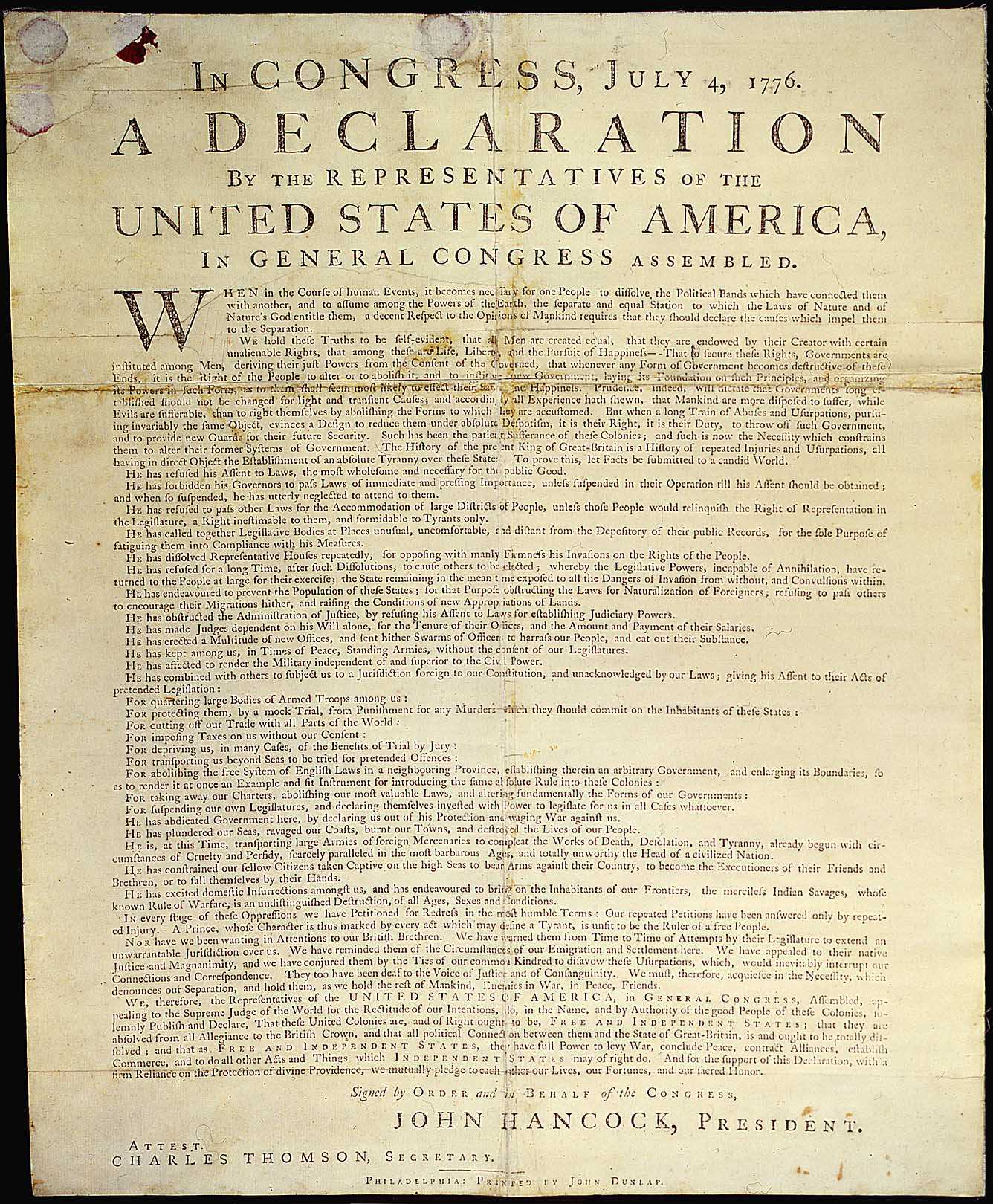
In accordance with the above order
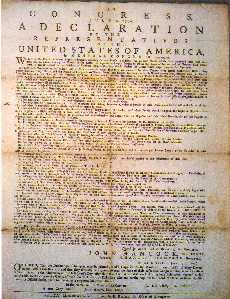
Philadelphia printer John Dunlap was given the task to print broadside copies of
the agreed-upon declaration to be signed in type only by Continental Congress
President John Hancock and Secretary Charles Thomson. Since New York had
not approved the Declaration of Independence the word Unanimous does not appear
on the July 4, 1776 Broadside.
Broadside Produced during the night of
July 4, 1776, by printer
John Dunlap
- Courtesy of the National Archives
Authenticate your Declaration of Independence
Click Here
John Dunlap is
thought to have printed 200 Broadsides that July 4th evening which were
distributed to the members of Congress on July 5th. It is a known fact that
John Hancock sent a copy on July 5th, 1776 to the Committee of Safety of
Pennsylvania, a copy to the Convention of New Jersey, and a copy to Colonel
Haslet with instructions to have it read at the head of his battalion. In
addition John Adams sent one copy, and Elbridge Gerry two copies, to friends.
The Declaration,
as affirmatively voted on July 4th, was not signed on that day by the attending
delegates. The New York Delegates were required by their legislature to abstain
from voting or signing any instrument of independence. John Hancock in an
attempt to quickly gain the unanimous consent from all thirteen colonies sent a
Dunlap broadside off to the NY Provincial Congress on Saturday July 6th.
The Declaration of Independence arrived, along with the NY Continental Congress
Delegates' July 2nd letter at the Provincial NY Congress new meeting site
at White Plains on July 9th. The members, at once, referred the letter and
a a copy of the Declaration of Independence to a committee from headed by John
Jay who had been an absent member from the Continental Congress due to his
duties in the New York Provincial Congress. John Jay, as chairman, reported a
resolution of his own drafting, which was unanimously adopted independence:
"That the reasons assigned by the Continental Congress for declaring the United
Colonies free and independent States are cogent and conclusive; and that while
we lament the cruel necessity which has rendered that measure unavoidable, we
approve the same, and will, at the risk of our lives and fortunes, join with the
other colonies in supporting it."[xiv]NY also adopted Jay's resolution that "five hundred copies
of the Declaration of Independence be ... published in handbills and sent to all
the County committees in this State." The next day the style of the New York
House was changed to the "Convention of the Representatives of the State of New
York."
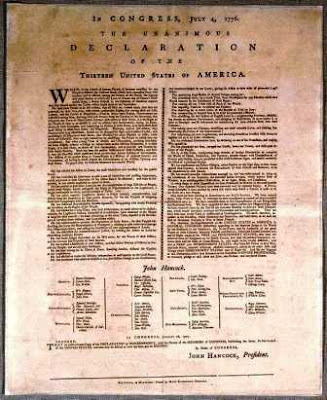
The New York
Resolution was laid before the Continental Congress on July 15th so then and not
before was it proper to entitle the document "The Unanimous Declaration of
the Thirteen States of America."
Among the resolutions passed by the Continental Congress on July, 4th 1776 was
one that called for the President John Hancock to send to several commanding
officers of the Continental army Dunlap printings of the Declaration of Independence,
Hancock sent a copy of the resolutions together with the "Dunlap Broadside"
of the Declaration to General George Washington on July 6, 1776. Washington had
the Declaration read to his assembled troops in New York on July 9th. Later that
night, the Americans destroyed a bronze and lead statue of King George III,
which stood at the foot of Broadway on the Bowling Green in celebration of the
Nation’s Independence. Washington's personal copy of the Dunlap printing of the
Declaration of Independence remains in the Manuscript Division's George
Washington Papers .[xxviii]
Today only
twenty-five of these Dunlap broadsides are known to exist. The original working
copy(ies) of the Declaration of Independence that was signed by Hancock and
Thomson on July 4, 1776 is/are lost. All we have left from the actual July 4th
event are the drafts and printings of John Dunlap. One of these unsigned
"Dunlap Broadsides", as it reported to have sold for $8.14
million in an
August 2000 New York City Auction.[xv]
This copy was discovered in 1989 by a man browsing in a flea market who
purchased a painting for four dollars because he was interested in the frame.
Concealed in the backing of the frame was an original Dunlap Broadside of the
Declaration of Independence.
The other
printings of the Dunlap Broadside known to exist are dispersed among private
owners, American and British institutions. The following are the current know
locations of the Dunlap Broadsides.
Harvard University,
Houghton Library - Massachusetts
Historical Society - Yale University,
Beinecke Rare Book & Manuscript Library - New York Historical
Society - New York Public
Library - American
Philosophical Society - Historical Society
of Pennsylvania - Independence
National Historical Park - Maryland Historical
Society - Library of Congress,
Rare Book and Special Collections Division - Library of Congress,
Manuscript Division - National Archives
and Records Service -Indiana University,
Lilly Library -University of
Virginia, Alderman Library - Public Record
Office, London, England (Admiralty Records) - Public Record
Office, London, England (Colonial Office 5) - Chicago Historical
Society - Maine Historical
Society - William H. Scheide,
Scheide Library, Princeton, New Jersey - Ira G. Corn, Jr.,
and Joseph P. Driscoll, Dallas, Texas - Anonymous, New York,
New York - Chew Family,
Philadelphia, Pennsylvania - John Gilliam Wood,
Edenton, North Carolina - Anonymous, purchased
at Sotheby's, December 1990 - Visual Equities,
Inc., Atlanta, Georgia [xvi]
In 1776 as the
Delegates returned home with their personal copies of the Dunlap Broadside each
State decided on how to disseminate the Declaration of Independence to its
citizens. Some states, like Virginia, chose newspapers while others, like New
York, ordered
official State Broadsides to be printed from the Dunlap Declaration of
Independence. The official printing, for instance, ordered by Massachusetts was
to be distributed to ministers of all denominations, to be read to their
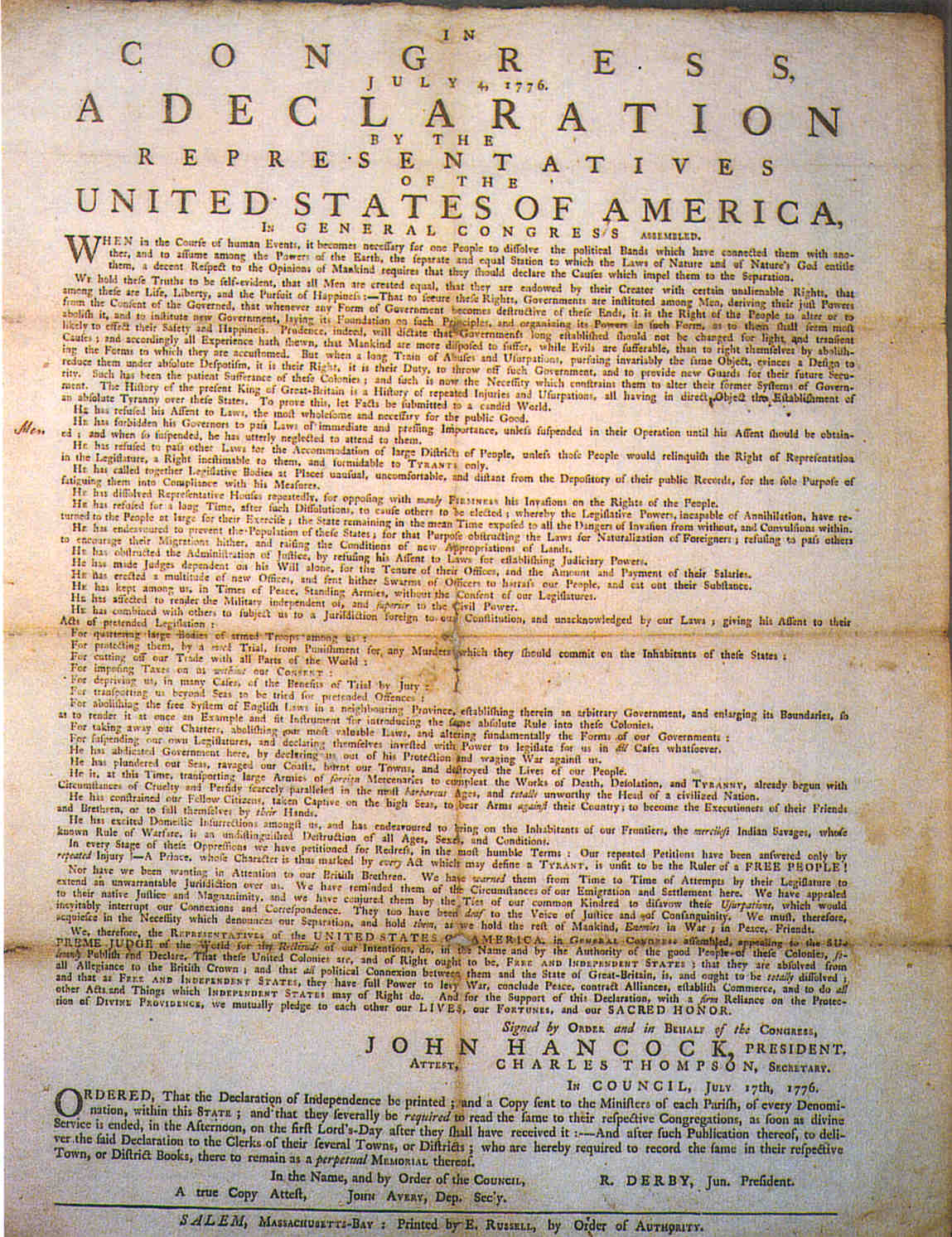
congregations. News of the declaration was proclaimed in every parish of
Massachusetts via this state printed broadside. In the absence of other media,
broadsides were subsequently distributed out among the colonies and
tacked to the walls of churches and other meeting places to spread news of
America's independence. These state broadsides all had the July 4th date but
many adding the corrected language "Unanimous Declaration" to their
headings with NY's ascension on July 9th.
Click Here to
enlarge a Massachusetts Broadside Courtesy of Stanley L. Klos
was replevined in
2001 by the State of Maine
Authenticate your Declaration of Independence
Click Here
Another
Philadelphia Printer, Henrich Millers, produced a German Newspaper in 1776
called the Pennsylvanisher staatsbote. On July 9, 1776 the newspaper
printed a full German translation of the American Declaration of Independence
and reported:
"Yesterday at noon, the Declaration of Independence, which is published on
this news paper's front page, was publicly proclaimed in English from an
elevated platform in t he courtyard of the State House. Thereby the United
Colonies of North America were absolved from all previously pledged allegiance
to the king of Great Britain, they are and henceforth will be totally free and
independent. The proclamation was read by Colonel Nixon, sheriff Dewees stood by
his side and many members of the Congress, of the [Pennsylvania] Assembly,
generals and other high army officers were also present. Several thousand
people were in the courtyard to witness the solemn occasion. After the reading
of the Declaration there were three cheers and the cry: God bless the free
states of North America! To this every true friend of these colonies can only
say, Amen. "
[xvii]
Miller did prepare
a full printing of the Declaration of Independence in a German-language
broadside on July 9th but historian Karl J.R. Arndt of Clark University claims
Miller was trumped by German printers Cist and Steiner. According to Clark,
Cist and Steiner produced an ordinary laid paper German Declaration of
Independence broadside, without a watermark, measuring 16 inches by 12 3/4
inches as early as July 6th, the day after Dunlap's printing .The author had the
privilege to inspect and hold this historic broadside that is now in the
archives of Gettysburg College. At the bottom center of the Declaration there is
an imprint appears as "Philadelphia: Gedruckt bey Steiner und Cist, in der
Zweyten-strasse."
Contrary to popular belief, two original July 5th, 1776 Dunlap printed
broadsides with only Hancock and Thomson's names were the actual documents
delivered to King George III notifying him of the resolution to absolve all ties
with Great Britain. King George III never received a signed copy with a John
Hancock’s signature large enough for him to read without his spectacles.
Aside from the Dunlap and Massachusetts broadsides there are 12 other
known contemporary broadside
editions of the Declaration of Independence. Nine have imprints
identifying their printers and place of publication, while five carry no
imprint. The low survival rate of all of the contemporary regional
printings of the Declaration-which were both utilitarian and intrinsically
ephemeral-makes identification of their printers particularly difficult.
None of these have the names of the other signers aside from John Hancock and
Charles Thomson. The other names of the signers
were not made public until 1777.
In 1776, the
Continental Congress had fled to Baltimore, Maryland due to mounting British
victories. Congress re-convened on 20 December 1776 and stayed in session until
March 4th, 1777. On January 18th, 1777, after victories at Trenton and
Princeton, John Hancock's Congress ordered a true copy of the Declaration of
Independence printed complete with the names of all the signers. Mary Katherine
Goddard, a Baltimore Postmaster, Printer and publisher, was given the original
engrossed copy of the Declaration to set the type in her shop. A copy of the
Goddard printing was ordered to be sent to each state so the people would know
the names of the signers:
Ordered, That an authenticated copy of the Declaration of Independency, with
the names of the members of Congress subscribing the same, be sent to each of
the United States, and that they be desired to have the same put upon record.
[xviii]
Authenticate your Declaration of Independence
Click Here
Today, there are
nine known Goddard broadsides that can be found.
Library of Congress, Connecticut State Library of the late John W. Garrett,
Maryland Hall of Records, Maryland Historical Society, Massachusetts Archives,
New York Public Library, Library Company of Philadelphia, Rhode Island State
Archives.
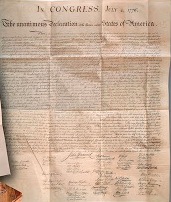
[xix]
The Engrossed Declaration of Independence
After the
Continental Congress learned N.Y. agreed to the declaration they ordered, on
July 19, 1776, that the Declaration be
"fairly engrossed on parchment, with the title and stile [sic] of 'The
unanimous declaration of the thirteen United States of America,' and that the
same, when engrossed, be signed by every member of Congress."
[xx]
Timothy Matlack,
a Pennsylvanian who had assisted the Secretary of the Congress, Charles Thomson
prepared the official document in a large, clear hand. Matlack was also the "scribe"
who wrote out George Washington's commission as commanding general of the
Continental Army which was also signed by President John Hancock. Finally on
August 2, 1776 the journal of the Continental Congress record reports: "The
declaration of independence being engrossed and compared at the table was
signed." which contradicts the popular belief that the Declaration was
executed by all the delegates in attendance on July 4, 1776.
According to the
-- National Archives and Records Administration:
"John Hancock, the President of the Congress, was the first to sign the sheet
of parchment measuring 24¼ by 29¾ inches. He used a bold signature centered
below the text. In accordance with prevailing custom, the other delegates began
to sign at the right below the text, their signatures arranged according to the
geographic location of the states they represented. New Hampshire, the
northernmost state, began the list, and Georgia, the southernmost, ended it.
Eventually 56 delegates signed, although all were not present on August 2. Among
the later signers were Elbridge Gerry, Oliver Wolcott, Lewis Morris, Thomas
McKean, and Matthew Thornton, who found that he had no room to sign with the
other New Hampshire delegates. A few delegates who voted for adoption of the
Declaration on July 4 were never to sign in spite of the July 19 order of
Congress that the engrossed document "be signed by every member of Congress."
Non-signers included John Dickinson, who clung to the idea of reconciliation
with Britain, and Robert R. Livingston, one of the Committee of Five, who
thought the Declaration, was premature."
[xxi]
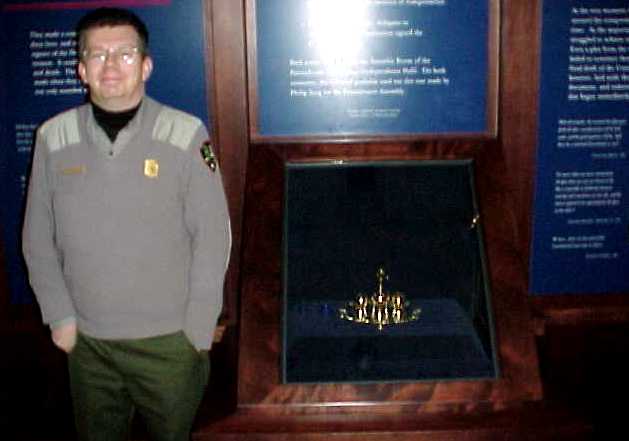
Click
Here to View the ink stand used to sign the Declaration of Independence -
Thank you Ranger Stewart A. W. Low
With the
signatures of 56 brave delegates, this new nation born in freedom with an
indivisible spirit, proclaimed on a singular piece of hand written parchment
their Unanimous Declaration of Independence from Great Britain. The
Declaration of Independence was safeguarded all throughout the revolutionary war
traveling with the Continental Congress to maintain its safety. The National
Archives lists the following locations of the Traveling Declaration since 1776:
Philadelphia: August-December 1776
Baltimore: December 1776-March 1777
Philadelphia: March-September 1777
Lancaster, PA: September 27, 1777
York, PA: September 30, 1777-June 1778
Philadelphia: July 1778-June 1783
Princeton, NJ: June-November 1783
Annapolis, MD: November 1783-October 1784
Trenton, NJ: November-December 1784
New York: 1785-1790
Philadelphia: 1790-1800
Washington, DC (three locations): 1800-1814
Leesburg, VA: August-September 1814
Washington, DC (three locations): 1814-1841
Washington, DC (Patent Office Building): 1841-1876
Philadelphia: May-November 1876
Washington, DC (State, War, and Navy Building): 1877-1921
Washington, DC (Library of Congress): 1921-1941
Fort Knox*: 1941-1944
Washington, DC (Library of
Congress): 1944-1952
Washington, DC (National Archives):
1952-present *Except that the document was displayed on April 13, 1943, at the
dedication of the Thomas Jefferson Memorial in Washington, D. C.
[xxii]
The original
Declaration, now exhibited in the Rotunda of the National Archives Building in
Washington, DC, has faded badly -- largely because of poor preservation
techniques during the 19th century and the wet ink transfer process of 1820
utilized to make vellum copies.
Unauthorized Site:
This site and its contents are not affiliated, connected,
associated with or authorized by the individual, family,
friends, or trademarked entities utilizing any part or
the subject's entire name. Any official or affiliated
sites that are related to this subject will be hyper
linked below upon submission
and Evisum, Inc. review.
Please join us in our mission to incorporate The Congressional Evolution of the United States of America discovery-based curriculum into the classroom of every primary and secondary school in the United States of America by July 2, 2026, the nation’s 250th birthday. , the United States of America: We The
People. Click Here